
Nuke Stage for led car process
Since we launched PlatePros, we've advocated for full 360° equirectangular plates as the gold standard for LED car process work. Part of that advocacy means working directly with playback companies around the world to make sure their software gives artists and stage crews the tools to actually take advantage of what equirectangular plates can do.
So we were pleased to be an early supporter of Foundry and their purpose-built ICVFX playback application, Nuke Stage and we continue to be impressed by how robust its 360° 2D plate toolset is.
Foundry has published an excellent set of training videos for getting up and running in Nuke Stage. A few of them are geared specifically to the LED car process workflow, and they proudly feature PlatePros plates as the training sample media.
Watch the training videos
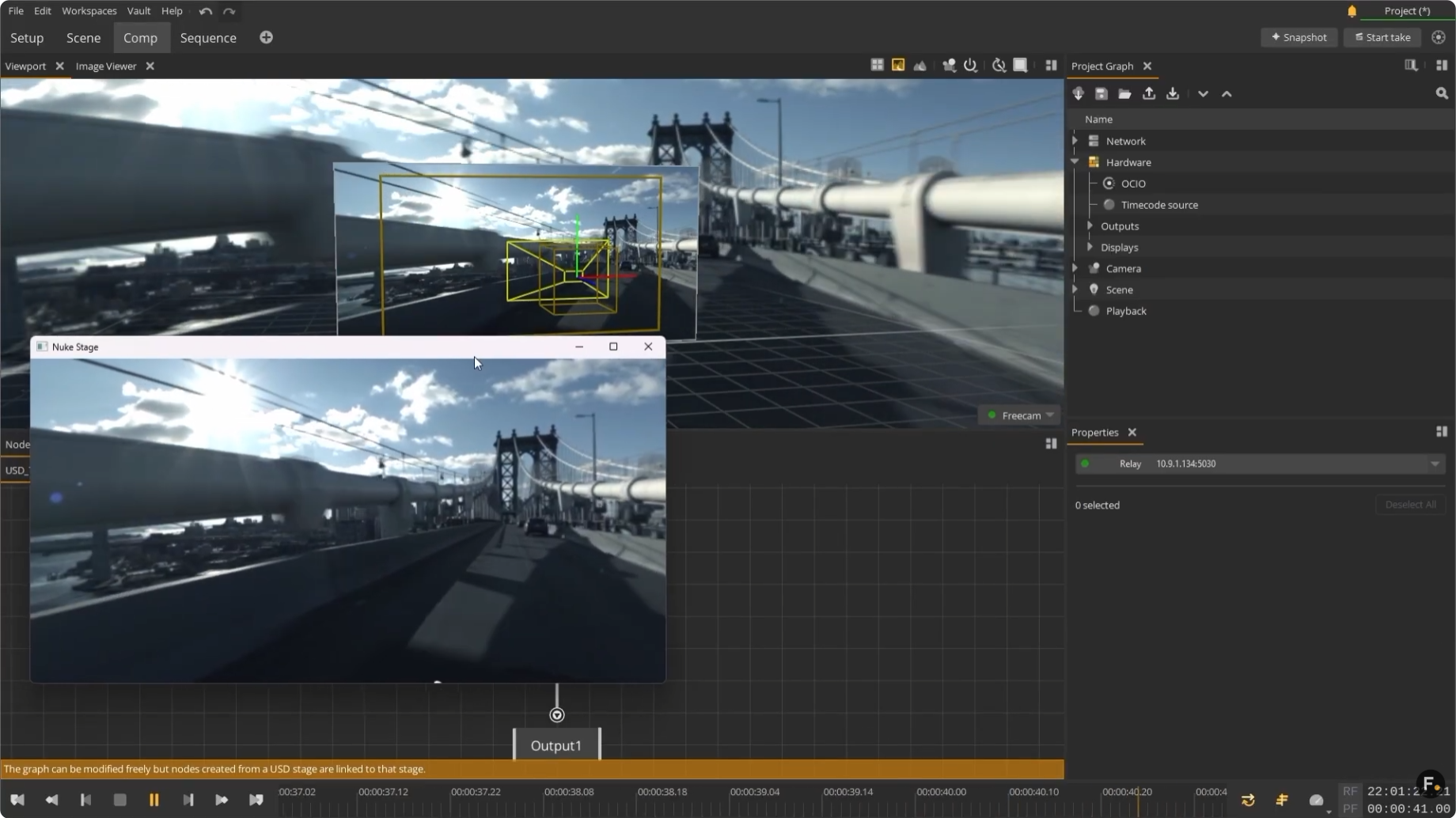
Part 4 of 7: Using 360 driving plates in Nuke Stage | Nuke Stage | Foundry
Moving into practical applications, this video features Courtney Pryce, Creative Director at XIVFX, outlining the process for setting up a 360 driving scene for virtual production using Nuke Stage. Featuring a PlatePros stitched driving plate of the Manhattan Bridge in daytime.
What is a 360° equirectangular plate?
An equirectangular plate is a single image that maps a full 360° × 180° spherical view onto one rectangular frame. Instead of shooting separate flat plates for left, right, rear, and front windows and stitching them together on the wall, the entire environment surrounding the picture vehicle lives in one continuous file.
For LED car process, that means one asset drives every screen on the volume, plus the reflections in the paint and glass.
Why equirectangular beats multiple flat plates for LED car process
One asset, no seams. Multiple flat plates have to be aligned to each other at the edges. Every seam is a place where the illusion can break: a mismatched horizon, a shifted vanishing point, a color offset between cameras. An equirectangular plate has no seams because it was never separate pieces.
Correct reflections. The plate is providing the environment for reflections in the windshield, the hood, the side glass, and the actor's eyes. Content that only covers the camera-facing screens can't light or reflect what's happening off-axis.
Simpler stage mapping. Feeding one spherical source to a multi-screen volume is a mapping problem the software solves. Feeding six separately-shot flat plates to a multi-screen volume is a continuity problem the crew solves, live, with the clock running.
Fewer versions to manage. One master plate serves any stage configuration. Flat plate sets are cut for a specific screen layout and have to be re-derived when the volume changes.
How does Nuke Stage handle 360° plates?
Nuke Stage is a purpose-built virtual production application from Foundry that plays photorealistic content back onto LED walls in real time. Notably, it doesn't require Nuke (despite the name, it's built on a separate technology stack) but it uses a node graph and color pipeline that will be immediately familiar to any Nuke compositor.
For 360° vehicle work, the pieces that matter are:
Native spherical handling so an equirectangular plate can be mapped to the volume without pre-slicing it into per-screen renders
On-set rotation and reframing, so heading changes are a creative note rather than a pipeline task
ACEScg, OCIO, and HDR color management, so the plate looks the same on the wall as it did in the grade and carries into post
B44 EXR and NotchLC playback, so you're not trading resolution for real-time performance
Camera tracking integration with Vicon, MoSys, OptiTrack and others, tying wall content to physical camera movement
The metadata Vault, which records on-set decisions so post starts where the stage left off
That combination is why we've been enthusiastic about Nuke Stage from early on: it treats the 360° plate as a first-class citizen rather than a format to be converted away from.
Why does Foundry use PlatePros plates as sample media?
Training media has to be representative of what the tool will encounter in production. PlatePros shoots purpose-built 360° equirectangular driving plates for LED volumes: captured, stitched, graded, and delivered in the formats ICVFX playback systems actually ingest.
Our library covers over a thousand locations throughout the US in both 12k and 16k. We also shoot custom 360° plates on request, to a production's specific route, time of day, weather, and vehicle height.
If you're working through the Nuke Stage tutorials, the plates in your hands are the same class of asset you'd receive on a real show.
Getting started
Foundry's Nuke Stage learning materials are at learn.foundry.com and product information is at foundry.com/products/nuke-stage.
If you're planning an LED car process shoot and want to talk through plate requirements — library options, custom capture, resolution and coverage for your specific volume — get in touch.